


Learning centers
-
Automation systems
- Shasta Single Cell System introduction
- SmartChip Real-Time PCR System introduction
-
ICELL8 introduction
- ICELL8 cx applications
- ICELL8 technology overview
- ICELL8 cx technical specifications
- ICELL8 technical specifications (original system)
- ICELL8 system vs plate-seq
- Webinars
-
Technical notes
- Enhancing biomarker discovery with SMART-Seq Pro kit and ICELL8 cx system
- ICELL8 cx system target enrichment for fusions
- ICELL8 cx system reagent formulation and dispense guidelines
- Improved detection of gene fusions, SNPs, and alternative splicing
- Full-length transcriptome analysis
- High-throughput single-cell ATAC-seq
- Protocol: High-throughput single-cell ATAC-Seq
- Single-cell identification with CellSelect Software
- Single-cell analysis elucidates cardiomyocyte differentiation from iPSCs
- Combined TCR profiling and 5’ DE in single cells
- Automated, high-throughput TCR profiling
- Sample preparation protocols
- Video resources
- Citations
- Posters
- System & software notices
- Apollo library prep system introduction
-
Next-generation sequencing
- Product line overview
-
RNA-seq
- Automated library prep
- Technologies and applications
-
Technotes
- Enabling long-read RNA sequencing from low-input samples
- Singular for low input total RNA seq
- All-in-one cDNA synthesis and library prep from single cells
- Automation-friendly, all-in-one cDNA synthesis and library prep
- All-in-one cDNA synthesis and library prep from ultra-low RNA inputs
- 3' mRNA libraries from single cells (SMART-Seq v4 3' DE Kit)
- Full-length mRNA-seq for target capture
- Stranded libraries from single cells
- Stranded libraries from picogram-input total RNA (v3)
- Stranded libraries from 100 pg-100 ng total RNA
- Stranded libraries from 100 ng - 1 ug total RNA
- Stranded libraries from FFPE inputs (v2)
- Nonstranded libraries from FFPE inputs
- Singular and Takara Bio library prep
- Full-length, single-cell, and ultra-low-input RNA-seq with UMIs
-
Webinars
- Pushing the limits of sensitivity for single-cell applications
- Capturing biological complexity by high-resolution single-cell genomics
- Taking single-cell RNA-seq by STORM
- STORM-seq Q&A
- Neural multiomics Q&A
- Liver metabolic function, dissecting one cell at a time
- Pushing the limits Q&A
- Total RNA sequencing of liquid biopsies
- Liver metabolic function Q&A
- Automating full-length single-cell RNA-seq libraries
- Single-cell whole transcriptome analysis
- Sensitivity and scale for neuron multiomics
- RNA-seq tips
- RNA-seq FAQs
-
Technical notes
-
DNA-seq
- Next-gen WGA method for CNV and SNV detection from single cells
- Low-input whole-exome sequencing
- DNA-seq from FFPE samples
- Low cell number ChIP-seq using ThruPLEX DNA-Seq
- Detection of low-frequency variants using ThruPLEX Tag-Seq FLEX
- ThruPLEX FLEX outperforms NEBNext Ultra II
- Streamlined DNA-seq from challenging samples
- High-resolution CNV detection using PicoPLEX Gold DNA-Seq
- ThruPLEX FLEX data sheet
- Low-volume DNA shearing for ThruPLEX library prep
- NGS library prep with enzymatic fragmentation
- Comparing ThruPLEX FLEX EF to Kapa and NEBNext
-
Immune Profiling
- Get started with BCR/TCR profiling
- Track B-cell changes in your mouse model
- Efficient and sensitive profiling of human B-cell receptor repertoire
- TCRv2 kit validated for rhesus macaque samples
- Improved TCR repertoire profiling from mouse samples (bulk)
- TCR repertoire profiling from mouse samples (bulk)
- BCR repertoire profiling from mouse samples (bulk)
- Improved TCR repertoire profiling from human samples (bulk)
- TCR repertoire profiling from human samples (single cells)
- BCR repertoire profiling from human samples (bulk)
- Epigenetic sequencing
- Reproductive health technologies
-
DNA-seq
- Technology and application overviews
- FAQs and tips
-
DNA-seq protocols
- Using UMIs with ThruPLEX Tag-Seq FLEX
- Targeted capture with Agilent SureSelectQXT
- Exome capture with Illumina Nextera Rapid Capture
- Targeted capture with Roche NimbleGen SeqCap EZ
- Targeted capture with IDT xGen panels
- Targeted capture with Agilent SureSelectXT
- Targeted capture with Agilent SureSelectXT2
- Bioinformatics resources
-
Webinars
- Harnessing the power of full-length transcriptome analysis for biomarker discoveries
- SMART-Seq Pro kits for biomarker detection
- Takara Bio Single-Cell Workshop, Spring 2021
- Single-Cell Workshop at 2020 NextGen Omics Series UK
- Immunogenomics to accelerate immunotherapy
- MeD-Seq, a novel method to detect DNA methylation
- Single-cell DNA-seq
- Posters
- Spatial omics
- mRNA and cDNA synthesis
-
Gene function
- Gene editing
-
Viral transduction
- Recombinant virus comparison
- Product finder
- Transduction posters
-
Lentivirus
- Lenti-X Transduction Sponge overview
- Webinars
- Customizable SARS-CoV-2 pseudovirus
- Lenti-X FAQs
- Lentiviral workflow
- Lentiviral products guide
- Lentivirus biosafety
- Lentiviral tips
- Lentiviral vectors
- Lenti-X packaging
- High-throughput lentivirus production
- Lenti-X Concentrator
- Lentiviral titration
- Lenti-X GoStix Plus video protocols
- Lenti-X GoStix Plus FAQs
- Rapid lentivirus titration by p24 ELISA
- Lentiviral particles
- Lentiviral particles—fluorescent
- Lentiviral particles FAQs
- Retrovirus
- Adeno-associated virus
- Adenovirus
- T-cell transduction and culture
- Inducible systems
- Transfection reagents
- Fluorescent proteins
- Cell biology assays
-
Stem cell research
- Overview
- Protocols
- Applications
-
Technical notes
- Pluripotent stem cells
-
Gene editing in hiPS cells
- Tagging an endogenous gene with AcGFP1 in hiPS cells
- Tagging an endogenous gene with a myc tag in hiPS cells
- Generating clonal hiPS cell lines deficient in CD81
- Introducing a tyrosinemia-related SNP in hiPS cells
- Inserting an expression cassette into the AAVS1 locus in hiPS cells
- Editing hiPS cells using electroporation
- Editing hiPS cells using gesicle technology
- Single-cell cloning of hiPS cells
- Organoids
- Beta cells
- Hepatocytes
- Cardiomyocytes
- Neural stem cells
- Posters
- Webinars
- Videos
- FAQs
-
Citations
- Cellartis MSC Xeno-Free Culture Medium
- Cellartis Power Primary HEP Medium
- Cellartis DEF-CS 500 Culture System
- Cellartis Enhanced hiPS-HEP cells
- Cellartis hPS cell-derived cardiomyocytes
- Cellartis iPS Cell to Hepatocyte Differentiation System
- GS1-R
- 2i mES/iPSC medium
- iMatrix-511
- 3i mES/iPSC medium
- NDiff 227
- NDiff N2
- RHB-A
- STEM101
- STEM121
- STEM123
- Selection guides
-
Protein research
- Capturem technology
- Antibody immunoprecipitation
-
His-tag purification
- Purification methods overview
- TALON resin selection guide
- Selection guide: His60 resin
- xTractor Buffer is optimized for superior protein yield
- Why tag a protein?
- Tech note: cobalt resin
- Simplified purification of active, secreted his-tagged proteins
- Overview: His60
- Tech note: Capturem technology
- Tech note: Capturem large volume
- Magnetic beads
- FAQs: TALON
-
Protocols
- Video: Capturem his maxiprep
- Video: Capturem his miniprep
- Visual protocol: Capturem his maxiprep
- Visual protocol: Capturem his miniprep
- Capturem nickel column reagent compatibility
- TALON reagent compatibility
- His60 reagent compatibility
- TALON: Native vs denaturing purification
- Protocol: denaturing purification with TALON resin, imidazole elution
- Protocol: native purification with TALON resin, imidazole elution
- Protocol: native purification with TALON resin, pH elution
- Other tag purification
- Phosphoprotein and glycoprotein purification
- Matchmaker Gold yeast two-hybrid systems
- Expression systems
-
PCR
- Citations
- PCR selection guide
- PCR enzyme brochure
-
Technical notes
- PrimeSTAR LongSeq DNA polymerase for long-read NGS
- Rapid, high-performance multiplex PCR
- EmeraldAmp outperforms MyTaq Red mix
- Fast and accurate PCR
- Methylation studies
- Hot-start PCR
- Long-range PCR with LA Taq
- Direct PCR from human nail
- Direct PCR from meat samples
- Megaprimer PCR with PrimeSTAR GXL
- Amplifying GC-rich templates
- Titanium Taq for high-throughput genotyping
- Colony PCR in under an hour
- High-throughput endpoint PCR
- Direct PCR from blood
- PrimeSTAR GXL for targeted sequencing
- Detecting somatic mosaicism using massively parallel sequencing
- FAQ
- Go green with lyophilized enzymes
-
Cloning
- Automated In-Fusion Cloning
-
In-Fusion Cloning general information
- In-Fusion Cloning overview
- In-Fusion Cloning guide
-
In-Fusion Cloning and competition
- In-Fusion Snap Assembly vs. GeneArt Gibson Assembly HiFi
- In-Fusion Snap Assembly vs. NEBuilder HiFi
- Sequence accuracy in seamless cloning
- Choosing a seamless cloning method
- Improving background over Gibson Assembly
- A successful alternative to ligation cloning
- Single- and multiple-insert cloning
- Easy cloning into lentiviral vectors
- Outperforming TOPO cloning
- In-Fusion Cloning citations
- Stellar Competent Cells product overview and performance data
- EcoDry reagents and sustainability
- Primer design and other tools
- In‑Fusion Cloning tips and FAQs
-
Applications and technical notes
- In-Fusion Cloning applications collection
- Efficient multiple-fragment cloning
- Mutagenesis with In-Fusion Cloning
- Rapid, high-throughput cloning for antibody development
- Solve a synthesis challenge with easy multiple-insert cloning
- Direct cloning into large vectors
- Simplified insertion of a GFP-encoding cassette into a 100-kb plasmid
- Efficient cloning for sgRNA/Cas9 plasmids
- In-Fusion Cloning of sgRNAs
- De novo insertion of small fusion protein tags
- Sign up to stay updated
-
Traditional molecular cloning
-
Restriction enzyme overview
- General information about restriction enzymes
- Star activity of restriction enzymes
- Inactivation of restriction enzymes
- Buffer activity with restriction enzymes
- Universal buffers for double digestion with restriction enzymes
- Restriction enzymes affected by methylation
- Methylation-sensitive restriction enzymes
- QC of restriction enzymes
- Ligation cloning overview
- Ligation product guide
-
Restriction enzyme overview
- In-Fusion Cloning webinars
-
Nucleic acid purification
- Nucleic acid extraction webinars
- Product demonstration videos
- Product finder
- Plasmid kit selection guide
- Plasmid purification
- Genomic DNA purification
- DNA/RNA cleanup and extraction
- RNA purification
- RNA purification kit finder
- Viral DNA and RNA purification
- Parallel DNA, RNA & protein
- Automated DNA and RNA purification
- Accessory selection guides
- Microbiome
- Antibodies and ELISA
-
Real-time PCR
- Download qPCR resources
- Overview
- Product finder
- Reaction size guidelines
- Real-time PCR products brochure
- Real-time PCR tutorial videos
- Guest webinar: extraction-free SARS-CoV-2 detection
-
Technical notes
- Unbiased preamplification of limited samples
- Accurate gene expression analysis with TB Green Premix Ex Taq II
- Efficient quantification of human gene expression with PrimeScript Reverse Transcriptase
- Rapid qPCR analysis from blood samples using PrimeScript Reverse Transcriptase
- Monitoring siRNA knockdown
- qPCR without optimization using TB Green Premix Ex Taq
- Fast synthesis of cDNA templates for real-time RT-PCR
- Specific, consistent real-time PCR with TB Green Premix Ex Taq II
- Mir-X microRNA quantification
- FAQs
Spatial omics resources
Reveal intricate spatial patterns with precise single-cell localization
We stand at the early stages of a revolutionary leap in biology. Spatial multiomics is lighting the way to an advanced understanding of the inner workings of human health and disease. Now, researchers can easily and affordably examine single-cell location and behavior with trailblazing Trekker and Seeker spatial mapping technologies. These innovations empower scientists to gain unprecedented insights into cellular interactions and their implications for various biological processes.
Trekker technology spotlight
Simplify spatial profiling
- One kit—eliminate expensive instrumentation
- One hour—add this fast and easy protocol upstream of single-nuclei NGS assays
- One location—pinpoint exact positions of single cells for the complete picture
Seeker technology spotlight
Illuminate gene expression
- Comprehensive—capture whole transcriptomes of single cells
- Universal—use the same workflow for any species, not just human and mouse
- Flexible—choose between two tile sizes
See how researchers add a new dimension to their experiments
Fill out the form below to access an on-demand webinar featuring a scientist from Stanford University who employed Trekker and Seeker technologies in his research.
Tracing the spatiotemporal evolution of cancer
In this webinar, Dr. Matthew Jones describes his recent work coupling high-resolution spatial transcriptomics with evolvable lineage-tracing technologies to elucidate how tumor expansion, plasticity, and metastasis co-evolve with microenvironmental remodeling in lung adenocarcinoma.

Topics covered:
- Hypoxic microenvironment associated with immunosuppressive and fibrotic cell states
- Origin of metastases from spatially confined subclones and their remodeling of the distant metastatic niche
- Integration of sequential changes in cancer cell state and microenvironmental structure that promote tumor progression

Matthew Jones, PhD
Postdoctoral Fellow, Stanford University
Dr. Matt Jones conducts research to develop computational and technological approaches to better understand dynamic biological systems, as applied to cancer. Currently, his projects include developing computational approaches for spatially-resolved lineage tracing technologies, and studying the mechanisms by which oncogene amplifications contribute to tumor progression and drug resistance.
Sign up to watch this webinar and get info about monthly webinars!
Dive deeper into spatial omics
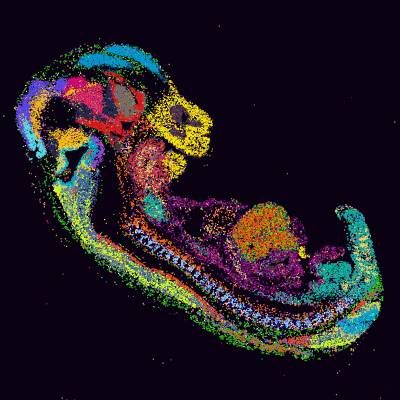
Explore Trekker resources
Acquire spatial and single-cell data in a single experiment, without sacrificing sensitivity or resolution.
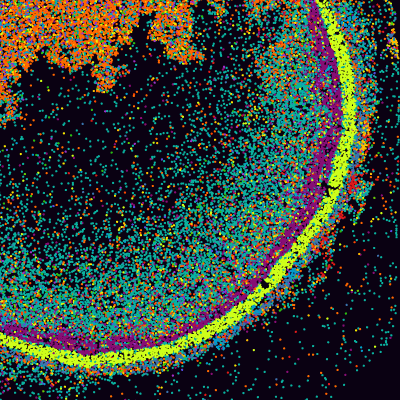
Explore Seeker resources
Accelerate discoveries with high-resolution, whole-transcriptome expression maps

View all spatial omics webinars
Webinar series: Advancing discovery with spatial multiomics—accessible tools for high-resolution insights.
Takara Bio USA, Inc.
United States/Canada: +1.800.662.2566 • Asia Pacific: +1.650.919.7300 • Europe: +33.(0)1.3904.6880 • Japan: +81.(0)77.565.6999
FOR RESEARCH USE ONLY. NOT FOR USE IN DIAGNOSTIC PROCEDURES. © 2025 Takara Bio Inc. All Rights Reserved. All trademarks are the property of Takara Bio Inc. or its affiliate(s) in the U.S. and/or other countries or their respective owners. Certain trademarks may not be registered in all jurisdictions. Additional product, intellectual property, and restricted use information is available at takarabio.com.
