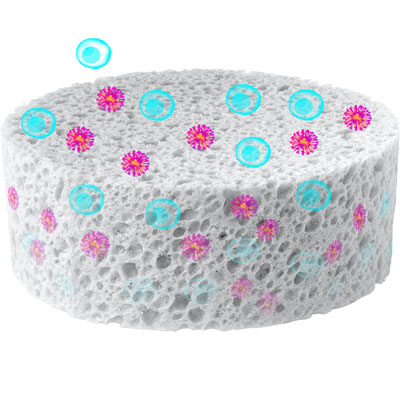
Lentiviral transduction sponge—efficient transduction with an easier workflow
Enhance lentiviral transduction efficiency in any cell type with dissolvable microfluidics
Get transduction efficiencies that are equal to or better than those achieved with spinoculation
Minimize cell handling and hands-on time with an easy workflow
Use the same protocol on a wide variety of cell types (including cell lines and primary cells)
Transduce a broad range of cell concentrations (1 x 10⁵–1 x 10⁷ cells per sponge)
Introduction
Researchers often struggle with low lentiviral transduction efficiency, which can seriously impact downstream applications. Lentiviral vectors are a popular tool for delivering genes into target cells for applications such as gene and protein expression, cell line development, therapeutic model generation, genome-wide screening, and CAR expression in T-cells. The current methods used to enhance cell-virus contact to improve transduction efficiency, such as spinoculation and chemical-based enhancers (e.g. polybrene), have their own limitations.
Microfluidic systems address some of these limitations by spatially constraining cells and virus to small areas to achieve high viral transduction efficiencies. However, previous applications of microfluidics for lentiviral transduction necessitated special chips and hardware to facilitate the flow of cells and virus through microfluidic channels. What if you could effectively transduce cells without additional hardware or special chemicals? Studies have shown that a macroporous 3D alginate sponge can help viral transduction efficiency without harming cells.
This microfluidic sponge is made from calcium-crosslinked alginate, a GMP-compliant, FDA-approved biomaterial with high biocompatibility and low toxicity. The crosslinked alginate undergoes a gentle cryogelation process, yielding a sponge with uniform pore sizes ranging from 20–300 µm.
The simple workflow involves applying a mixture of cells and virus to the sponge, a short incubation of 1 hr for absorption, media addition, and harvesting the next day. The release of transduced cells is facilitated by adding a chelating release buffer that depolymerizes the sponge, ensuring the efficient release of transduced cells.
Simple workflow & format
Figure 1. Simple transduction workflow using the Lenti-X Transduction Sponge. Cells and virus are mixed prior to applying to the sponge. The transduction mixture is incubated for 1 hr, followed by the addition of media and overnight incubation for 16–24 hr. No spinoculation is required. The next day, healthy, transduced cells are released using an optimized Release Buffer that depolymerizes the alginate matrix. Cells are then ready for subsequent analysis or continued culture.
Figure 2. Convenient format for use with a 24-well tissue culture plate. Panel A. Each kit comprises 24 individual sponges, each capable of facilitating transduction of up to 1 x 10⁷ cells. Panel B. Every sponge features a complex microfluidic pore structure with pore sizes ranging from 20–300 µm. The image shown is at 150x magnification. Panel C. Simple placement of the transduction sponge into a well before the application of the sample. Panel D. The transduction mix, consisting of 1 x 10⁵–1 x 10⁷ cells and virus, is added to the sponge and incubated for 1 hr before the addition of media and incubation for 16–24 hr. Panel E. Cell release is facilitated by transferring the sponge to a 15 ml conical tube and adding Release Buffer, followed by a short wash step.
Transduction efficiency compared to spinoculation
A common method to enhance lentiviral transduction efficiency is to incorporate spinoculation, the use of centrifugation to bring lentivirus and cells into closer proximity. Chemical-based enhancers may also be added. Use of the Lenti-X Transduction Sponge results in equivalent or better transduction efficiencies along with an easier workflow. It is designed to maximize transduction efficiency across a diverse array of cell targets, including both suspension and adherent cell types.
The alginate sponge demonstrated efficient transduction of over 15 cell types, including human primary T cells, CD34+ HSCs, NK cells, and adherent cell lines (Figure 3), with high viability (Figure 4). This allows flexibility in using the lentiviral sponge across diverse cell types without much optimization.
Figure 3. The Lenti-X Transduction Sponge facilitates transduction at equivalent levels to spinoculation in multiple cell types.Panel A. 1 x 10⁶ Jurkat cells were transduced with lentivirus expressing ZsGreen1 at the indicated MOIs using spinoculation or the Lenti-X transduction sponge. The spinoculation cultures were centrifuged for 90 min at 1400 x g at 32°C in the presence of 8 µg/ml polybrene. Sponge cultures were treated as described in Figure 1. All transductions were analyzed at 48 hr post-transduction for ZsGreen1 expression by FACS. Panel B. To further compare sponge transduction to spinoculation (spin in the figure), a variety of cell lines were transduced with ZsGreen1 lentivirus at several multiplicity of infections (MOIs), as described in Panel A.
Figure 4. The Lenti-X Transduction Sponge enhances primary T-cell transduction efficiency while preserving viability.Panel A. Human primary T cells were activated using MHC tetramer, anti-CD3/CD28-coated beads, Retronectin reagent (RN) + CD3, or CD3 only. Activation levels indicated by percentage CD69+ expression at 48 hr are displayed. Then, 1 x 10⁶ activated cells were transduced with lentivirus encoding ZsGreen1 at the specified MOI using the transduction sponge for 24 hrs. FACS analysis was performed at 48 hr post-transduction to determine %ZsGreen1 expression. Panel B. Viability at 48 hr post-transduction as determined by 7-AAD staining and FACS analysis.
Consistent transduction
Sponge-based transductions demonstrate flexibility and can accommodate a wide range of cell amounts (from 1 x 10⁵–1 x 10⁷ cells) and types, transduction volumes (50–150 µl), and incubation times (4–16 hr). Sponge-based transductions are consistent, with a coefficient of variation <15%.
Figure 5. The Lenti-X Transduction Sponge demonstrates consistent transduction efficiency across varying cell amounts and transduction times with low inter-sponge variability. Panel A. Jurkat cells were transduced with a lentivirus encoding ZsGreen1 at specified cell numbers and MOIs using either a RetroNectin reagent + spinoculation (RN + spin) protocol or the transduction sponge for 24 hr. Panel B. Increasing numbers of Jurkat cells were transduced for 4, 9, 24 or 48 hr using the transduction sponge with a lentivirus expressing ZsGreen1 (MOI = 10). Panel C. 1 x 10⁶ Jurkat cells were transduced with lentivirus expressing ZsGreen1 (MOI=2.5) in six replicates weekly for 4 weeks to assess inter-run variability (%CV = 12.6). For all experiments, ZsGreen1 expression was analyzed by FACS 48 hr post-transduction to determine %ZsGreen positive cells and MFI. The average ZsGreen1 expression across all replicates is shown in red (AVG).
Conclusions
The innovative ex vivo Lenti-X Transduction Sponge is a user-friendly transduction enhancer based on dissolvable microfluidics technology. It is compatible with diverse cell types, providing efficiencies equal to or surpassing conventional protocols.
The Lenti-X Transduction Sponge workflow produces transduction efficiencies that are equal to or better than spinoculation.
A simple workflow minimizes cell handling and hands-on time.
Allows the transduction of a wide variety of cell types including CD34 HSCs, NK cells, and T cells.
Can transduce a wide range of cell amounts (1 x 10⁵–1 x 10⁷ per sponge) enabling downstream applications requiring large number of transduced cells.