


Lenti-X Transduction Sponge
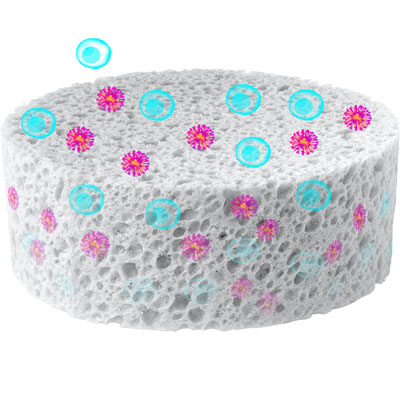
The Lenti-X Transduction Sponge is a novel technology that allows you to achieve microfluidics-driven lentiviral transduction efficiency gains without the use of microfluidics-based instrumentation. With one sponge, you can transduce 105–107 cells without the need for time-consuming spinoculation or harsh, chemical transduction enhancers that require optimization to retain cell viability. The Lenti-X Transduction Sponge is effective in transducing a wide variety of cell types, including cell lines and difficult-to-transduce primary cells.
How does the Lenti-X Transduction Sponge work?
The Lenti-X Transduction Sponge is a novel technology that allows you to achieve microfluidics-driven lentiviral transduction efficiency gains without the use of microfluidics-based instrumentation. With one sponge, you can transduce 105–107 cells without the need for time-consuming spinoculation or harsh chemical transduction enhancers that require optimization to retain cell viability. The Lenti-X Transduction Sponge enables you to effectively transduce a wide variety of cell types, including cell lines and difficult-to-transduce primary cells.
How does the Lenti-X Transduction Sponge work?
A mixture of target cells and lentivirus is added onto the sponge and incubated for 1 hr at 37°C to allow the mixture to be absorbed. Following absorption, cell culture media is added to the sponge and then incubated at 37°C for 16–24 hr.
The following day, you can easily release the transduced cells by dissolving the sponge in a special release buffer. These cells can then be replated for further expansion and downstream applications. The user-friendly protocol minimizes cell handling and requires smaller total reaction volumes, reducing the amount of virus needed. The Lenti-X Transduction Sponge consistently delivers transduction efficiencies comparable to or superior to traditional methods.
Overview
A better alternative to standard lentiviral transduction methods.
- Achieve microfluidics-driven lentiviral transduction efficiency gains without the use of microfluidics-based instruments
- Skip labor-intensive, time-consuming spinoculation that requires additional centrifugation equipment
- Transduce 105–107 cells in the volume required for only one well of a 24-well plate with each sponge
- Use the same easy protocol on a wide variety of cell types (including cell lines and primary cells)
- End reliance on chemical-based enhancers (e.g. polybrene) that are toxic to certain cell types and require optimization to maintain cell viability during and after transduction.
Easy-to-use workflow that reduces cell handling

The Lenti-X Transduction Sponge workflow
More Information
Applications
- Lentiviral transduction for the following applications:
- Gene expression
- Protein expression
- Cell line generation
- Therapeutic model generation
- Whole-genome screening
- CAR-T research using lentivirus for gene modification
- Transduction of retrovirus and virus-like particles (VLPs)
Additional product information
Please see the product's Certificate of Analysis for information about storage conditions, product components, and technical specifications. Please see the Kit Components List to determine kit components. Certificates of Analysis and Kit Components Lists are located under the Documents tab.
Takara Bio USA, Inc.
United States/Canada: +1.800.662.2566 • Asia Pacific: +1.650.919.7300 • Europe: +33.(0)1.3904.6880 • Japan: +81.(0)77.565.6999
FOR RESEARCH USE ONLY. NOT FOR USE IN DIAGNOSTIC PROCEDURES. © 2025 Takara Bio Inc. All Rights Reserved. All trademarks are the property of Takara Bio Inc. or its affiliate(s) in the U.S. and/or other countries or their respective owners. Certain trademarks may not be registered in all jurisdictions. Additional product, intellectual property, and restricted use information is available at takarabio.com.
