



iDimerize regulated transcription system

iDimerize technology can be used to tightly control transcription activation of target genes using chemically induced dimerization of a DNA binding domain and a transcription activation domain. A key advantage of this iDimerize approach to transcription control is its low background. This is possible because the transcriptional activation domain (AD) is physically separated from the DNA prior to addition of the dimerizer ligand.
iDimerize technology can be used to tightly control transcription activation of target genes using chemically induced dimerization of a DNA binding domain and a transcription activation domain. A key advantage of this iDimerize approach to transcription control is its low background. This is possible because the transcriptional activation domain (AD) is physically separated from the DNA prior to addition of the dimerizer ligand.
Transcription factors are bifunctional proteins that recognize specific DNA sequences near target genes (via the DNA binding domain) and then recruit the transcriptional machinery of the cell to activate transcription (via the transcriptional AD). These two domains can work together to activate transcription even when they are expressed as individual proteins and brought together by the A/C Heterodimerizer ligand.
A/C Heterodimerizer Ligand (AP21967)
The A/C Heterodimerizer is a synthetic, cell-permeable ligand that can be used to induce heterodimerization of two fusion proteins. For example, when used with this kit, the DmrC-tagged transcription AD can be induced to dimerize with the DmrA-tagged DNA binding domain. The A/C Heterodimerizer is identical to AP21967, which was previously supplied by ARIAD Pharmaceuticals Inc.
Regulating transcription
Sequentially transfect your cells of interest with:
- A plasmid which expresses the transcription activation and DNA binding components (pHet-Act1-2)
- Your gene of interest cloned downstream of the PZI-1 inducible promoter (in pZFHD1-2)
The DNA binding component remains bound to the promoter at all times, but it cannot activate transcription until it interacts with the transcription activation component via the DmrA and DmrC domains. When the A/C Heterodimerizer is added, the two components interact, and your gene of interest is transcribed from the PZI-1 promoter.


Overview
- Tightly regulated transcription using iDimerize technology
- Dose-dependent, small molecule control of transcription
- Activation domain is physically separated from the DNA prior to addition of the dimerizer ligand, resulting in low background
- A/C Heterodimerizer is identical to the AP21967 ligand
More Information
Applications
- Inducing gene expression in a ligand-dependent manner
- Analyzing genes that promote cell death, block the cell cycle, or are otherwise toxic
- Functional genomics research
Product citations
Pomerantz, J. L., Sharp, P. A., & Pabo, C. O. Structure-based design of transcription factors. Science 267(5194), 93–96 (1995).
Additional product information
Please see the product's Certificate of Analysis for information about storage conditions, product components, and technical specifications. Please see the Kit Components List to determine kit components. Certificates of Analysis and Kit Components Lists are located under the Documents tab.
Tighly controlled expression system that is as easy to use as any constitutive system
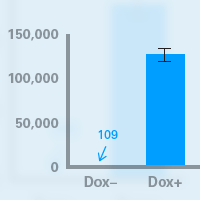
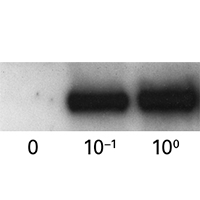
Until now, the best inducible mammalian expression systems have all required a two-vector format. Tet-One inducible expression systems are the only commercially available single-vector systems that can deliver a >10,000-fold difference in expression levels between induced and uninduced states.
Tet-One technology overview All inducible systemsTakara Bio USA, Inc.
United States/Canada: +1.800.662.2566 • Asia Pacific: +1.650.919.7300 • Europe: +33.(0)1.3904.6880 • Japan: +81.(0)77.565.6999
FOR RESEARCH USE ONLY. NOT FOR USE IN DIAGNOSTIC PROCEDURES. © 2025 Takara Bio Inc. All Rights Reserved. All trademarks are the property of Takara Bio Inc. or its affiliate(s) in the U.S. and/or other countries or their respective owners. Certain trademarks may not be registered in all jurisdictions. Additional product, intellectual property, and restricted use information is available at takarabio.com.
