



Inducible protein stabilization
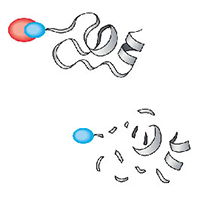
ProteoTuner technology allows you to regulate the amount of your protein of interest present in the cell, quickly and on demand. It uses a 12-kDa ligand-dependent destabilization domain, derived from an unstable FKBP12 mutant, that is fused to your protein of interest. Addition of a membrane-permeant small molecule, Shield1, reversibly stabilizes the fusion protein in a rapid, predictable, and dose-dependent manner.
ProteoTuner technology allows you to regulate the amount of your protein of interest present in the cell, quickly and on demand. It uses a 12-kDa ligand-dependent destabilization domain, derived from an unstable FKBP12 mutant, that is fused to your protein of interest. Addition of a membrane-permeant small molecule, Shield1, reversibly stabilizes the fusion protein in a rapid, predictable, and dose-dependent manner. The ProteoTuner system makes it possible to change the amount of a protein of interest rapidly, so it is possible to observe even the quickest cellular processes, such as cytoskeletal rearrangement in cells, by simply expressing the protein of interest as a DD-tagged fusion and controlling its stability by adding or removing Shield1.
One-vector/one-ligand system
- A 12-kDa destabilizing domain (DD) that, when fused to a protein of interest, destabilizes the protein by targeting it for proteasomal degradation. Plasmid, retroviral, and lentiviral ProteoTuner vectors are available that carry the DD domain for fusion at either the N or C terminus of your protein.
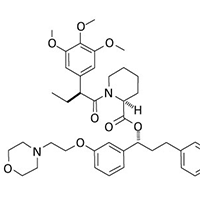
- A membrane-permeable small molecule (750 Da) ligand, Shield1, which protects the DD-fusion protein from being degraded and allows it to accumulate in the cell. Stabilization of the DD protein occurs in as little as 15–30 minutes.
Featured link

ProteoTuner technology overview
Learn more about rapid, precise control of protein levels.
Inducible systems learning centers
Tet-inducible systems
Tet-On 3G, Tet-One, and Tet-Off systems.
iDimerize systems
Dimerizer ligand-dependent control of protein-protein interactions.
ProteoTuner systems
Shield1 ligand-dependent control of protein stability/degradation.
Takara Bio USA, Inc.
United States/Canada: +1.800.662.2566 • Asia Pacific: +1.650.919.7300 • Europe: +33.(0)1.3904.6880 • Japan: +81.(0)77.565.6999
FOR RESEARCH USE ONLY. NOT FOR USE IN DIAGNOSTIC PROCEDURES. © 2025 Takara Bio Inc. All Rights Reserved. All trademarks are the property of Takara Bio Inc. or its affiliate(s) in the U.S. and/or other countries or their respective owners. Certain trademarks may not be registered in all jurisdictions. Additional product, intellectual property, and restricted use information is available at takarabio.com.
