




One-step vs. two-step RT-qPCR—tips for choosing the right protocol
Introduction
Not sure whether to use a one-step or a two-step reverse transcription protocol? We’re here to help. Real-time PCR (qPCR) is a powerful and common technique for accurate analysis of gene expression. When starting with RNA samples, you first need to perform a reverse transcription (RT) step in order to generate cDNA for the qPCR experiment. In one-step RT-qPCR, the RT step takes place in the same tube as the qPCR. In two-step RT-qPCR, the RT and qPCR steps take place in separate tubes. Both techniques have advantages and limitations, so it is essential to consider which protocol suits your workflow.
One-step RT-qPCR workflow

The advantages
- Simple and rapid
- Works well when performing a small number of assays
- Amenable to high-throughput applications
In general, one-step RT-qPCR is best suited for high-speed, high-throughput applications. The single-tube protocol is easy to set up and can be used for processing many samples using liquid handlers or other high-throughput systems. This allows for less hands-on-time and reduces the chances of pipetting errors or contamination. The one-step approach works best when used in workflows containing many samples with a limited number of targets.
The limitations
- Unable to optimize RT step
- Does not generate stocks of cDNA
However, one-step RT-qPCR has some limitations. Since both the RT and qPCR steps take place in the same tube, the reaction conditions cannot be optimized separately. This can lead to lower yields or efficiency in either step. Another limitation is that all the cDNA generated is used up in the subsequent qPCR step. This means that no stocks of cDNA can be banked for further validation or experimentation.
Two-step RT-qPCR workflow

The advantages
- High sensitivity, works well with limited sample input
- Able to optimize RT and qPCR steps separately
- Can generate cDNA stocks
Two-step RT-qPCR is best suited for applications requiring flexibility and sensitivity. The two-tube protocol makes it possible to optimize the RT and qPCR steps separately, ensuring maximum specificity and efficiency. This approach works best with workflows analyzing many targets in fewer samples. Another advantage is that two-step RT-qPCR generates cDNA in a separate tube from the qPCR reaction. This allows cDNA stocks to be banked so that they can be used for additional targets or validation.
The limitations
- More time-consuming
- Less amenable to high-throughput applications
Two-step RT-qPCR has some limitations as well. In general, the protocols are more time-consuming and involve more pipetting steps. This introduces more variability and increases the risk of contamination. Additionally, while the ability to optimize both the RT and qPCR steps separately can improve sensitivity and efficiency, it comes with the drawback of having to optimize two reactions instead of one. Lastly, the two-tube protocol cannot be as easily adapted to automated, high-throughput workflows, necessitating more hands-on-time.
Summary
Choosing the right protocol is critical for ensuring optimal performance and consistency. Generally, one-step RT-qPCR is best suited for applications requiring high-speed and high-throughput amplification of many samples with few targets, at the cost of potential efficiency and yield. Two-step RT-qPCR excels at allowing optimization, which provides greater sensitivity and flexibility, but reduces throughput. Depending on your workflow and needs, one of these reverse transcription protocols may be a better choice than the other. Explore our selection guide to find the right kit for your application.
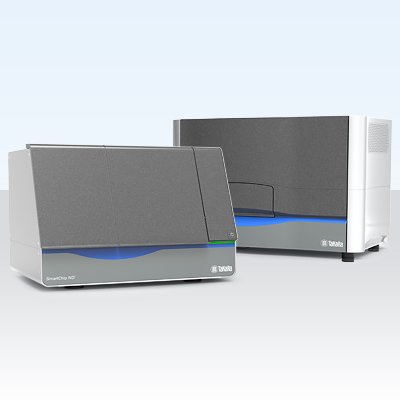
Unlock answers with nanoscale PCR
Takara Bio's SmartChip ND Real-Time PCR System allows you to flexibly design your own panels, keep costs low, and obtain results in under 3 hr. Sample dispensing and reaction mix distribution is automated for up to 5,184 reactions per chip. Customizable configurations allow 12 to 384 assays to be processed at a time, depending on the number of targets in the panel. The system also simplifies your workflow with full end-to-end software to carry out automated dispensing and qPCR analysis.
Learn moreTakara Bio USA, Inc.
United States/Canada: +1.800.662.2566 • Asia Pacific: +1.650.919.7300 • Europe: +33.(0)1.3904.6880 • Japan: +81.(0)77.565.6999
FOR RESEARCH USE ONLY. NOT FOR USE IN DIAGNOSTIC PROCEDURES. © 2025 Takara Bio Inc. All Rights Reserved. All trademarks are the property of Takara Bio Inc. or its affiliate(s) in the U.S. and/or other countries or their respective owners. Certain trademarks may not be registered in all jurisdictions. Additional product, intellectual property, and restricted use information is available at takarabio.com.
