



Which single-cell RNA-seq method detects more genes in cells with low RNA content?
Thinking about how to improve your next single-cell RNA-seq study? Or are you new to this technique and not sure where to begin? We have the benchmarking study for you.
Single-cell RNA-seq experiments have two major phases: cDNA generation and library preparation. Because our SMART-Seq Single Cell PLUS Kit gives you the tools to do both, we compared it to several other popular methods.
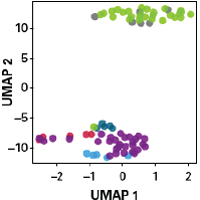
The cDNA-generation component of the kit (SSsc) was compared against the popular homebrew protocol, Smart-seq2 (SS2), and its update, Smart-seq3 (SS3). The library prep component (SSlp) was benchmarked against a commonly used method, Illumina Nextera® XT. We tested several inputs, cultured cells (Panel A), primary cells (Panel B), and whole organ RNA (Panel C). We also checked performance on two widely used liquid handlers, the MANTIS Liquid Dispenser and the mosquito HV. Finally, we analyzed the data using our CogentAP bioinformatics software.

Workflow diagram from Holcomb et al. J. Biomol. Tech. 32 (2021). Used with permission from Association of Biomolecular Resource Facilities.
To see exactly how this end-to-end-solution detected more genes while maintaining compatibility with automation and miniaturization, read "Benchmarking single-cell mRNA-sequencing technologies uncovers differences in sensitivity and reproducibility in cell types with low RNA content" in the December issue of the Journal of Biomolecular Techniques.
Complete SMART-Seq cDNA synthesis and library preparation from single cells
High-quality, full-length RNA-seq libraries from single cells (e.g., PBMCs) and nuclei.
All-in-one cDNA synthesis and library prep from single cells
Takara Bio USA, Inc.
United States/Canada: +1.800.662.2566 • Asia Pacific: +1.650.919.7300 • Europe: +33.(0)1.3904.6880 • Japan: +81.(0)77.565.6999
FOR RESEARCH USE ONLY. NOT FOR USE IN DIAGNOSTIC PROCEDURES. © 2025 Takara Bio Inc. All Rights Reserved. All trademarks are the property of Takara Bio Inc. or its affiliate(s) in the U.S. and/or other countries or their respective owners. Certain trademarks may not be registered in all jurisdictions. Additional product, intellectual property, and restricted use information is available at takarabio.com.
